
Here’s what I’m working on lately: a paper on folk horror films for the College English Association conference in Atlanta, Georgia.
THE GENRE
Scholarship about horror often highlights the genre’s ability to “render abject the subject of its gaze” (Chambers 12). 1980s body horror resonated with the AIDS epidemic, just as the Saw franchise is best understood in the context of the invasion of Iraq, and the zombie craze of the 2010s in the context of the Great Recession. Despite its rapid cult following, there is less consensus about folk horror.
Jamie Chambers notes that “theoretical approaches to folk horror remain in their infancy” (10) and Paul Cowdell writes that while “clear generic definitions are elusive,” the genre has a distinct atmosphere: folk horror films “rely on location in a landscape that acquires almost the status of an active character” whose influence results in what Adam Scovell calls “‘skewed belief systems and morality’ [enabling] the plots’ actual ‘happening/summoning’” (Cowdell 296).
Others have argued that folk horror exploits rural communities as sensational and backwards. As Chambers puts it, “folk denotes a productive way of seeing with an unstable inference of us and them” (17). Elsewhere, Cowdell argues that folk horror necessarily relies upon interdisciplinary interests in folklore studies, claiming that “The Wicker Man, then, would not exist without the development of an actual discipline of folklore” (309).
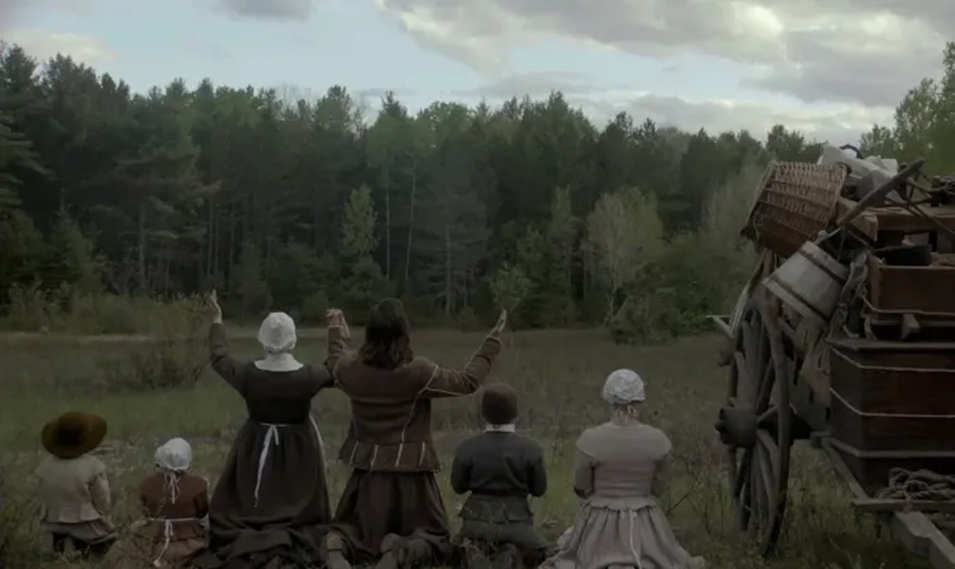
Is folk horror merely the abjection of folklore? While I find it admirably subversive to suggest that because the movies we love are just reboots of older folk stories, then we are not, in fact, morally or socially better than our ancestors, I also find this definition limiting. With obvious exceptions (The Witch), the legends in folk horror are usually fictitious. The traditions that drive the imagined peasant communities in Children of the Corn, The Wicker Man, and The Blood on Satan’s Claw are diegetic imitations of actual folklore.
Instead, folk horror is defined by the countryside, historicized between economic relations. Antonio Gramsci’s words on the subject are now famous to the point that they’re a meme: “The old world is dying, and the new world struggles to be born. Now is the time of monsters.” The question I want to pursue is whether or not those monsters are the peasants left behind by modernity, or modernity itself.
THE UNHOLY TRINITY
Most scholars agree that three unrelated English films, known informally as the Unholy Trinity, mark the first era of folk horror: Witchfinder General (1968), The Blood on Satan’s Claw (1971), and The Wicker Man (1973).
Witchfinder General is based on the real self-proclaimed witchfinder Matthew Hopkins, who abuses his authority in seventeenth century England. The Blood on Satan’s Claw portrays the satanic influence of Pagan artifacts on rural youths, who can only be saved by a witchfinder-like state agent. Meanwhile, The Wicker Man depicts a neo-Pagan Scottish cult whose mere existence challenges the English state’s internal stability by selecting a devout Anglican police officer for human sacrifice.
The most striking thing about these films is how ideologically incongruent they are. Whatever binds them together, then, is their shared depiction of an unresolved conflict between agricultural communities and an increasingly powerful class of landowners.
ENCLOSURE AND THE COMMONS

Economies in Europe were structurally and politically diverse during the thousand-year reign of feudalism, but were mostly built on social contracts between peasants who lived on the land and lords who held religious and political titles to that land. Peasants were also granted access to parcels of common land useful for procuring firewood, hunting and gathering, and grazing.
As early as the 1200s, feudal lords began violating those contracts by terminating customary rights to fish, graze, hunt, or harvest. Ellen Meiksins Wood writes that “enclosure meant the extinction, with or without a physical fencing of land, of common and customary use rights on which many people depended for their livelihood” (83). A much larger wave of enclosures began in the sixteenth century, placing the means by which one lives to see another day—food, water, and shelter—exclusively under market forces.
“As a result, enclosure could lead to the elimination of small owner-occupiers, who were bought out by large proprietors” (623), writes S. J. Thompson. Meanwhile, Silvia Federici notes the relationship between enclosure and the violence of the witch trials. In Caliban and the Witch, she writes, “women were those who suffered most when the land was lost and the village community fell apart” because “a nomadic life exposed them to male violence” (73).
Folk horror calls back to what capital presumes to be extinct: the practice of holding resources in common. Witchfinder General portrays the agents of enclosure as monstrous, cruel figures. In contrast, The Blood on Satan’s Claw suggests that enclosure is a necessary step in social progress, and The Wicker Man depicts a community struggling to recreate premodern agricultural (emphasis on cultural) conditions.
THE HORROR OF MATERIAL CONDITIONS
One central premise of folk horror is that people and wilderness should be separate, that monstrosity emerges from too close an association with the land. This is the logic of Enlightenment-era liberalism. John Locke explicitly argued that land can only be considered property if the people on that land use it for profit, or as he called it, improvement.
Thompson writes that “improvers defended enclosure on the grounds that it was more compatible with individual liberty than the open-field system it replaced” (639). Employing the rhetoric of natural liberty and natural rights, the agents of enclosure redefined nature itself. Locke argued that “the value inherent in land comes not from nature, but from labor,” which in Wood’s assessment means that, for Locke, “unimproved land is waste” (Wood 85). In the sixteenth century, improvement looked like agriculture. By the 1960s, agricultural spaces had replaced the commons as the imagined backwaters of modernity.

This is much more evident in the US corollary to English folk horror, known as hicksploitation. Ranging from Deliverance (1972) to The Texas Chainsaw Massacre (1974), American “hillbilly horror” is arguably more exploitative. In these films, isolated (usually white) communities in overgrown landscapes become monstrous. These films center harsh landscapes that are difficult to “improve,” despite the most industrious efforts of long-gone colonialist projects, which themselves become the subject of more recent American folk horror. The Witch (2015) and The Wind (2018) both emphasize the isolation of frontier spaces.
For Chambers, “the pleasures of the folk aesthetic frequently arise from depictions of cultural-geographic difference” (26). While I think Chambers underestimates the critical thinking skills of horror fans, his observation that the appeal of films like The Wicker Man for western liberal audiences is an imagined rural authenticity seems correct. Folk horror scratches a very particular itch; it confirms about ourselves whatever we want it to.
Today, there are dozens of studies about a contemporary epidemic of loneliness, contrasting a genre of memes about the desire to leave modern society and live in a cabin in the woods, to “retvrn with a V” to “the past,” because “medieval peasants” presumably worked fewer hours and because life was somehow “better” in “the past.” These memes traffic in the same metonymy for “the good old days” that folk horror encodes with monstrosity.
With more scholarship, I want to explore the ways that recent folk horror has reinterpreted landscapes from wastelands into spaces of mystery and open exploration, ecologically but also historically and economically, where present conditions can be seen, with both admiration and disgust, in sharp relief from afar.
Chambers, Jaime. “Troubling Folk Horror: Exoticism, Metonymy, and Solipsism in the ‘Unholy Trinity.’ Journal of Cinema and Media Studies, vol. 61, no. 2, Winter 2022, pp. 9-34. EBSCO, https://doi.org/10.1353/cj.2022.0014. Accessed 3 October, 2023.
Cowdell, Paul. “‘Practicing Witchcraft Myself During the Filming.’ Folk Horror, Folklore, and the Folkloresque.” Western Folklore, vol. 78, no. 2, Fall 2019, pp. 295-326. JSTOR. https://www.jstor.org/stable/10.2307/26864166. Accessed 18 October, 2023.
Federici, Silva. Caliban and the Witch. Autonomedia, 2014.
Thompson, S.J. “Parliamentary Enclosure, Property, Population, and the Decline of Classical Republicanism in Eighteenth-Century Britain. The Historical Journal, vol. 51, no. 3, 2008, pp. 621-642. JSTOR, https://www.jstor.org/stable/20175187. Accessed 19 March, 2024.
Wood, Meiksins Ellen. The Origins of Capitalism. Monthly Review Press, 1999.
 Last week, I had the pleasure of watching the 1987 Danish film
  Keene Short