
Here’s what I’m working on lately: a paper on fictional chefs in contemporary food films for the Southwest Popular/American Culture Association Conference in Albuquerque, New Mexico.
EATING ON SCREEN
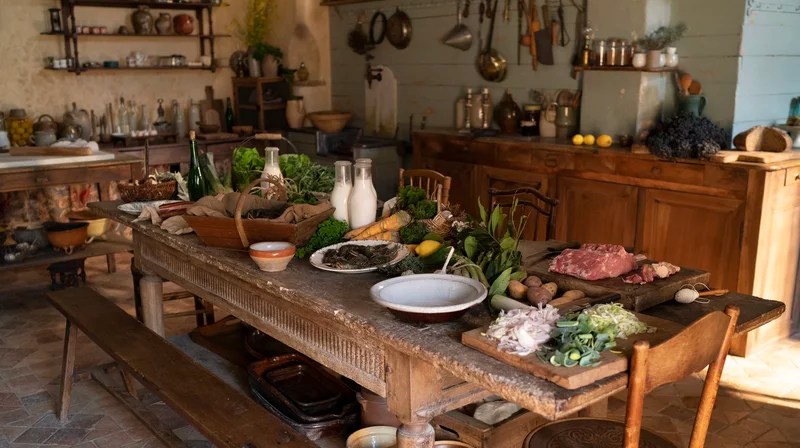
A January, 2023 article in Collider by Anthony Oleszkiewicz titled “How Movies Ate the Rich in 2022” lists films like Barbarian, Kimi, Infinity Pool, Bodies Bodies Bodies, Triangle of Sadness, Glass Onion, and most notably The Menu as films that “found a lot of joy in tearing down the privilege of money.” Oleszkiewicz defines “eat the rich” movies by their ability to “[separate] the wealthy from the audience’s eyes.” But most of these films only portray rich people “eating” each other, with almost no working-class characters on screen. While these movies might be cathartic, they inadvertently obscure the working class.
Nevertheless, there does seem to have been genuine interest in working-class interiority in the last five years, most notably in fictional depictions of restaurant work. Like the FX series The Bear, films like First Cow, Pig, The Menu, Boiling Point, and The Taste of Things center culinary labor from the perspective of industry-wide cooks. Furthermore, the explicitly culinary settings help to situate the role of labor, and not just class struggle, in contemporary cinema.
FOOD FILMS AND FICTIONAL CHEFS
Writing that “[food] and media condition the consumption of each other,” Laura A. Lindenfeld marks Babette’s Feast (1987) as the point at which “critics began to use the term ‘food film’” to describe movies in which food and its preparation “provide the central driving force for the films’ narrative structure” (5-7). Steve Zimmerman echoes this trajectory, noting that “the preparation and cooking of everyday meals and the slow-paced, uninteresting process of eating” could only become central narrative elements after the technical refinement of color, sound, and the close-up shot (Zimmerman 1-3). Only in the 1970s could filmmakers employ these techniques in a “New Hollywood free from the practices of the studios” (18) that constricted recycled well-worn narrative templates.
Celebrity chefs follow a different trajectory. Krishnendu Ray describes Julia Child as “surrounded by the spectacle of domesticity” when The French Chef premiered in 1963 (52). Through television, Ray adds, Child “would become the epitome of the TV chef, which in itself is an intermediate position between the home cook and the restaurant chef” (53) to domesticate “the work of spectacular cooking” comparable to the spectacle of the nineteenth century surgeon performing operations in a theater for public consumption (54). As they adopted increasingly theatrical backdrops, celebrity chefs gravitated away from the domestic sphere and back once again into public realm of the market. Chefs like Mario Batali, Paul Hollywood, and Anthony Bourdain portrayed their own culinary labor as professional expertise for and among other professional experts, distancing themselves from the domestic origins of that very profession.
CLASS AND LABOR
Because food preparation is the defining element in the food film genre, these discussions about how to define that preparation—as a domestic chore, as an artistic craft, as skill in the workforce—contextualize the relationship between culinary labor and class status.
Working-class life appeared more often in Hollywood during the 1970s, with films like Norma Rae, Saturday Night Fever, and Blue Collar. Derek Nystrom contends that “the new visibility of working-class characters in the 1970s was generated by a series of middle-class concerns” (5). Depictions of working-class life served to stabilize the middle-class status of independent filmmakers. More pointedly, Nystrom’s description of middle-class audiences during this time resonates with the presumptions underlying food films today. “What is at the heart of the middle-class’s fascination with representation of working-class life and experience” he writes, “is the forms of political association, resistance, and struggle these cinematic subjects bring to life—forms of political being that the middle class has trouble imagining itself inhabiting” (178).

Under capitalism, workers sell their labor in units of time to bosses. What matters in this formulation is that capital compensates labor quantitatively through hourly wages, but uses labor qualitatively as a resource. Fredric Jameson writes that “it is the use value of the worker’s commodity of labor power which is disengaged from its exchange value and suddenly made to produce more value than it is worth” (50), addressing the thorny question at the heart of Marx’s own analysis, “how is surplus value possible?” (52). David Harvey’s explanation is that there “is a key distinction between what labor gets and what labor creates. Surplus-value results from the difference between the value [that] labor congeals in commodities in a working day and the value the laborer gets for surrendering labor-power as a commodity” (124). In restaurant work, there is even a saying that exemplifies qualitative exploitation: “If you have time to lean, you have time to clean.” If a restaurant serves one customer or 200, cooks still make the same hourly wage at the end of a shift.
If movies about working-class characters in the 1970s allowed middle-class viewers to entertain ideas of solidarity and community-building practices that were absent from their day jobs, what experiences do contemporary audiences see in depictions of culinary labor?
A CORPUS OF CHEFS
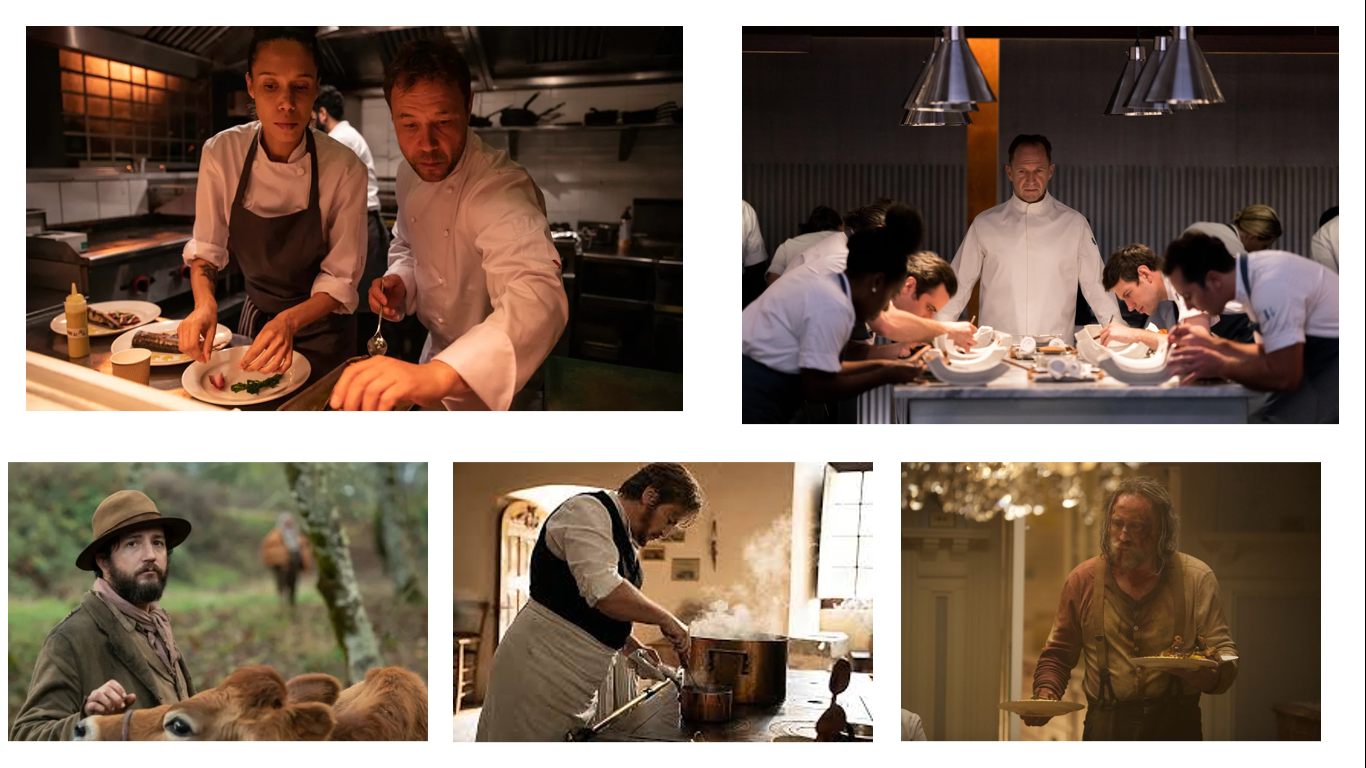
Five food films in the last half-decade provide a cursory sampling. Kelly Reichardt’s 2019 First Cow follows a pioneer outfit’s cook, known as Cookie, as he settles into life in an Oregon territorial outpost in the 1820s. At heart, Cookie is a baker who finds joy in making a type of donut that his new friend, Lu, convinces him to sell for profit. Because the key ingredient is milk, Cookie and Lu resort to secretly milking the territory’s only cow, owned by a wealthy colonialist.
In the same region two centuries later, Michael Sarnoski’s Pig (2021) features Chef Feld, who abandoned his restaurant in Portland’s fine dining scene after his wife’s death to live as a hermit in the woods, accompanied only by his truffle pig. When a restaurant owner steals the pig, Feld stumble back into the scene, only to be told he “doesn’t exist.” In order to regain his in-group status, Feld enters an underground wrestling competition with other chefs. Scarred, bloodied, most likely concussed, he earns his “existence” in the culinary world again.
Debuting the same year, Philip Barantini’s Boiling Point (2021) portrays Chef Andy Jones after a food inspector has downgraded his high-end restaurant from a 5 to a 3 for violations he is legally responsible for, while juggling the specific needs of individual customers and in-house tensions among the staff he oversees.
The pressures of high-end cuisine likewise set the stage for Mark Mylod’s “eat the rich” horror comedy The Menu (2022), in which Chef Julian Slowik delivers one final course to a patronage of elite diners. As part of his revenge, he reveals to these same customers their own selfish contradictions and abuses, at one point imprinting tax records onto fresh tortillas. Chef Slowik’s judgment is a product of his contempt for his peers rather than the system they support.
Bringing culinary labor back to the nineteenth century, Trần Anh Hùng’s 2023 The Taste of Things follows the gourmand Dodin and his cook and romantic partner, Eugénie, in rural France in the 1890s. Emphasizing the physical intimacy inherent to culinary labor, Dodin uses food to woo Eugénie into marriage, resituating culinary labor back in the domestic sphere as a skill for workers to use for their own delight. Customers, titles, and kitchen hierarchy are almost entirely absent. Furthermore, the film portrays Eugénie as a head chef and Dodin as a home cook, reversing the culinary gender roles prevalent in many other food films.
Unlike the working-class films of the 1970s, there is little solidarity here. Rather, these five chefs—Cookie, Feld, Jones, Slowik, and Dodin—wrestle with their own isolation. Pig, The Menu, and Boiling Point depict gourmet chefs confronting the emptiness of their own success, while First Cow is about the impossibility of achieving success in a world of privatized resources. Only in The Taste of Things does culinary labor act as a form of consolation against the challenges of ordinary life.
Each film depicts culinary labor as distinct from the brutalizing power of capitalist exploitation, which the protagonists inevitably extend to their own bodies, their own selves, to sell their labor value. Still, the culinary world suggests to audiences the possibility of class mobility, which most of these chefs manage to achieve by commodifying not just their labor, but their identities. Even Chef Slowik is not immune to the sentimentality of his first love—flipping burgers.
There are, of course, many other food films in the last five years that add even more layers of nuance. The Welsh-language horror film The Feast (2021) introduces environmental revenge into the culinary scene, while Fresh (2022) takes another stab at the role of gender in class exploitation.
What I find compelling in these films is the possibility that labor can be seen in sharp relief from the forces that exploit it. By centering the experiences of cooks, contemporary food films can draw a distinction between labor and capital, thus pinning the blame for class disparity on an exploitative system rather than the exploitative actions of bad actors in an otherwise fair system. In contrast to the class commentary underlying Triangle of Sadness or Infinity Pool, the recent trend in food films suggests that filmmakers are once again curious about the real, complex lives of working-class characters, a curiosity that I think has far too often been reserved for the wealthy.
Harvey, David. A Companion to Marx’s Capital. Verso Books, 2010.
Jameson, Fredric. Representing Capital. Verso Books, 2014.
Lindenfeld, Laura A. “Feasts for our eyes: Viewing films on food through new lenses.” Food as Communication, Communication as Food, edited by Janet M. Cramer, Carlnita P. Greene, & Lynn M. Walters, Peter Lang Publishing Inc., 2011, pp. 3-21.
Nystrom, Derek. Hard Hats, Rednecks, and Macho Men. Oxford University Press, 2009.
Oleszkiewicz, Anthony. “From Glass Onion to The Menu, How Movies Ate the Rich in 2022.” Collider 19 January, 2023, https://collider.com/movies-class-criticism-2022/. Accessed February 8, 2025.
Ray, Krishnendu. “Domesticating Cuisine: Food and Aesthetics on American Television.” Gastronomica vol. 7, no. 1, 2007, pp. 50-63, https://www.jstor.org/stable/10.1525/gfc.2007.7.1.50. Accessed January 13, 2025.
Zimmerman, Steve. Food in the Movies, 2ned Edition. McFarland Books, 2009.
 Keene Short