Category Archives: Works in Progress

Works in Progress, 3: Culinary Labor and Food Films

Here’s what I’m working on lately: a paper on fictional chefs in contemporary food films for the Southwest Popular/American Culture Association Conference in Albuquerque, New Mexico.
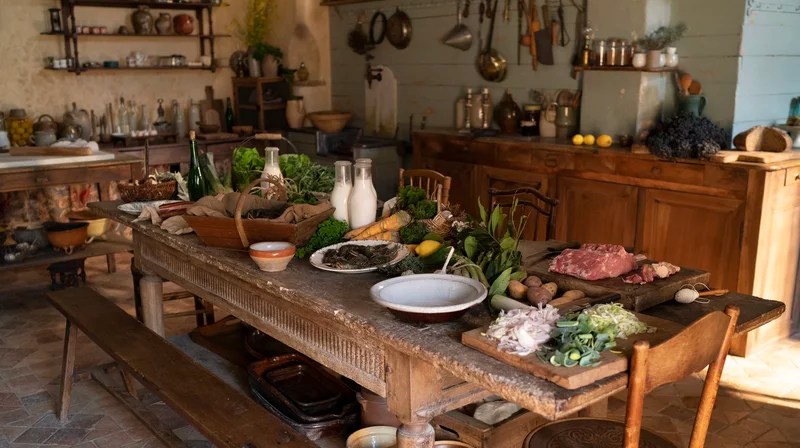
A nineteenth century kitchen in The Taste of Things.

EATING ON SCREEN         

A January, 2023 article in Collider by Anthony Oleszkiewicz titled “How Movies Ate the Rich in 2022” lists films like Barbarian, Kimi, Infinity Pool, Bodies Bodies Bodies, Triangle of Sadness, Glass Onion, and most notably The Menu as films that “found a lot of joy in tearing down the privilege of money.” Oleszkiewicz defines “eat the rich” movies by their ability to “[separate] the wealthy from the audience’s eyes.” But most of these films only portray rich people “eating” each other, with almost no working-class characters on screen. While these movies might be cathartic, they inadvertently obscure the working class.

Nevertheless, there does seem to have been genuine interest in working-class interiority in the last five years, most notably in fictional depictions of restaurant work. Like the FX series The Bear, films like First Cow, Pig, The Menu, Boiling Point, and The Taste of Things center culinary labor from the perspective of industry-wide cooks. Furthermore, the explicitly culinary settings help to situate the role of labor, and not just class struggle, in contemporary cinema.

FOOD FILMS AND FICTIONAL CHEFS

Writing that “[food] and media condition the consumption of each other,” Laura A. Lindenfeld marks Babette’s Feast (1987) as the point at which “critics began to use the term ‘food film’” to describe movies in which food and its preparation “provide the central driving force for the films’ narrative structure” (5-7). Steve Zimmerman echoes this trajectory, noting that “the preparation and cooking of everyday meals and the slow-paced, uninteresting process of eating” could only become central narrative elements after the technical refinement of color, sound, and the close-up shot (Zimmerman 1-3). Only in the 1970s could filmmakers employ these techniques in a “New Hollywood free from the practices of the studios” (18) that constricted recycled well-worn narrative templates.

Celebrity chefs follow a different trajectory. Krishnendu Ray describes Julia Child as “surrounded by the spectacle of domesticity” when The French Chef premiered in 1963 (52). Through television, Ray adds, Child “would become the epitome of the TV chef, which in itself is an intermediate position between the home cook and the restaurant chef” (53) to domesticate “the work of spectacular cooking” comparable to the spectacle of the nineteenth century surgeon performing operations in a theater for public consumption (54). As they adopted increasingly theatrical backdrops, celebrity chefs gravitated away from the domestic sphere and back once again into public realm of the market. Chefs like Mario Batali, Paul Hollywood, and Anthony Bourdain portrayed their own culinary labor as professional expertise for and among other professional experts, distancing themselves from the domestic origins of that very profession.

CLASS AND LABOR

Because food preparation is the defining element in the food film genre, these discussions about how to define that preparation—as a domestic chore, as an artistic craft, as skill in the workforce—contextualize the relationship between culinary labor and class status.

Working-class life appeared more often in Hollywood during the 1970s, with films like Norma Rae, Saturday Night Fever, and Blue Collar. Derek Nystrom contends that “the new visibility of working-class characters in the 1970s was generated by a series of middle-class concerns” (5). Depictions of working-class life served to stabilize the middle-class status of independent filmmakers. More pointedly, Nystrom’s description of middle-class audiences during this time resonates with the presumptions underlying food films today. “What is at the heart of the middle-class’s fascination with representation of working-class life and experience” he writes, “is the forms of political association, resistance, and struggle these cinematic subjects bring to life—forms of political being that the middle class has trouble imagining itself inhabiting” (178).

Oily cakes ready for the market in First Cow.

Under capitalism, workers sell their labor in units of time to bosses. What matters in this formulation is that capital compensates labor quantitatively through hourly wages, but uses labor qualitatively as a resource. Fredric Jameson writes that “it is the use value of the worker’s commodity of labor power which is disengaged from its exchange value and suddenly made to produce more value than it is worth” (50), addressing the thorny question at the heart of Marx’s own analysis, “how is surplus value possible?” (52). David Harvey’s explanation is that there “is a key distinction between what labor gets and what labor creates. Surplus-value results from the difference between the value [that] labor congeals in commodities in a working day and the value the laborer gets for surrendering labor-power as a commodity” (124). In restaurant work, there is even a saying that exemplifies qualitative exploitation: “If you have time to lean, you have time to clean.” If a restaurant serves one customer or 200, cooks still make the same hourly wage at the end of a shift.

If movies about working-class characters in the 1970s allowed middle-class viewers to entertain ideas of solidarity and community-building practices that were absent from their day jobs, what experiences do contemporary audiences see in depictions of culinary labor?

A CORPUS OF CHEFS
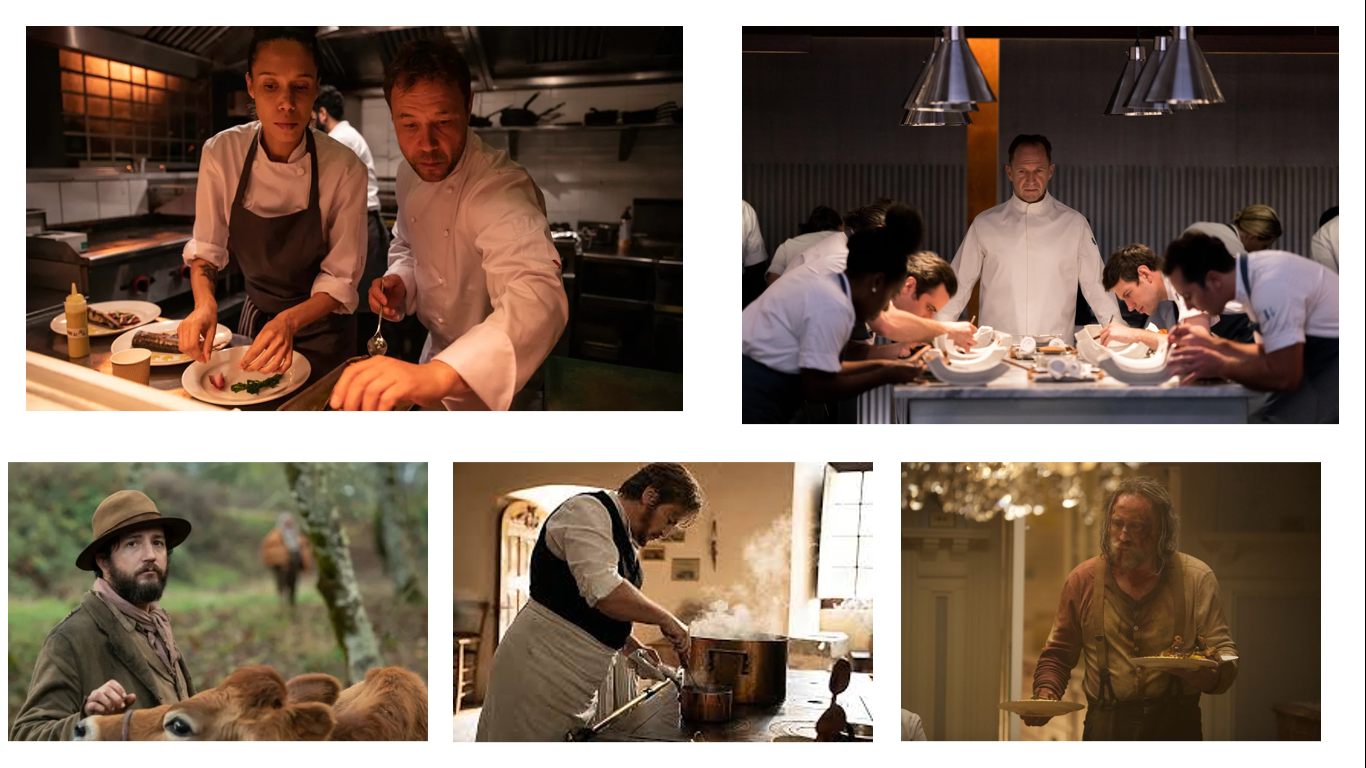
Left to right, top to bottom, five protagonists in Boiling Point, The Menu, First Cow, The Taste of Things, and Pig.

Five food films in the last half-decade provide a cursory sampling. Kelly Reichardt’s 2019 First Cow follows a pioneer outfit’s cook, known as Cookie, as he settles into life in an Oregon territorial outpost in the 1820s. At heart, Cookie is a baker who finds joy in making a type of donut that his new friend, Lu, convinces him to sell for profit. Because the key ingredient is milk, Cookie and Lu resort to secretly milking the territory’s only cow, owned by a wealthy colonialist.

In the same region two centuries later, Michael Sarnoski’s Pig (2021) features Chef Feld, who abandoned his restaurant in Portland’s fine dining scene after his wife’s death to live as a hermit in the woods, accompanied only by his truffle pig. When a restaurant owner steals the pig, Feld stumble back into the scene, only to be told he “doesn’t exist.” In order to regain his in-group status, Feld enters an underground wrestling competition with other chefs. Scarred, bloodied, most likely concussed, he earns his “existence” in the culinary world again.

Debuting the same year, Philip Barantini’s Boiling Point (2021) portrays Chef Andy Jones after a food inspector has downgraded his high-end restaurant from a 5 to a 3 for violations he is legally responsible for, while juggling the specific needs of individual customers and in-house tensions among the staff he oversees.

The pressures of high-end cuisine likewise set the stage for Mark Mylod’s “eat the rich” horror comedy The Menu (2022), in which Chef Julian Slowik delivers one final course to a patronage of elite diners. As part of his revenge, he reveals to these same customers their own selfish contradictions and abuses, at one point imprinting tax records onto fresh tortillas. Chef Slowik’s judgment is a product of his contempt for his peers rather than the system they support.

Bringing culinary labor back to the nineteenth century, Trần Anh Hùng’s 2023 The Taste of Things follows the gourmand Dodin and his cook and romantic partner, Eugénie, in rural France in the 1890s. Emphasizing the physical intimacy inherent to culinary labor, Dodin uses food to woo Eugénie into marriage, resituating culinary labor back in the domestic sphere as a skill for workers to use for their own delight. Customers, titles, and kitchen hierarchy are almost entirely absent. Furthermore, the film portrays Eugénie as a head chef and Dodin as a home cook, reversing the culinary gender roles prevalent in many other food films.

Unlike the working-class films of the 1970s, there is little solidarity here. Rather, these five chefs—Cookie, Feld, Jones, Slowik, and Dodin—wrestle with their own isolation. Pig, The Menu, and Boiling Point depict gourmet chefs confronting the emptiness of their own success, while First Cow is about the impossibility of achieving success in a world of privatized resources. Only in The Taste of Things does culinary labor act as a form of consolation against the challenges of ordinary life.

Each film depicts culinary labor as distinct from the brutalizing power of capitalist exploitation, which the protagonists inevitably extend to their own bodies, their own selves, to sell their labor value. Still, the culinary world suggests to audiences the possibility of class mobility, which most of these chefs manage to achieve by commodifying not just their labor, but their identities. Even Chef Slowik is not immune to the sentimentality of his first love—flipping burgers.

There are, of course, many other food films in the last five years that add even more layers of nuance. The Welsh-language horror film The Feast (2021) introduces environmental revenge into the culinary scene, while Fresh (2022) takes another stab at the role of gender in class exploitation.

What I find compelling in these films is the possibility that labor can be seen in sharp relief from the forces that exploit it. By centering the experiences of cooks, contemporary food films can draw a distinction between labor and capital, thus pinning the blame for class disparity on an exploitative system rather than the exploitative actions of bad actors in an otherwise fair system. In contrast to the class commentary underlying Triangle of Sadness or Infinity Pool, the recent trend in food films suggests that filmmakers are once again curious about the real, complex lives of working-class characters, a curiosity that I think has far too often been reserved for the wealthy.


Harvey, David. A Companion to Marx’s Capital. Verso Books, 2010.

Jameson, Fredric. Representing Capital. Verso Books, 2014.

Lindenfeld, Laura A. “Feasts for our eyes: Viewing films on food through new lenses.” Food as Communication, Communication as Food, edited by Janet M. Cramer, Carlnita P. Greene, & Lynn M. Walters, Peter Lang Publishing Inc., 2011, pp. 3-21.

Nystrom, Derek. Hard Hats, Rednecks, and Macho Men. Oxford University Press, 2009.

Oleszkiewicz, Anthony. “From Glass Onion to The Menu, How Movies Ate the Rich in 2022.” Collider 19 January, 2023, https://collider.com/movies-class-criticism-2022/. Accessed February 8, 2025.

Ray, Krishnendu. “Domesticating Cuisine: Food and Aesthetics on American Television.” Gastronomica vol. 7, no. 1, 2007, pp. 50-63, https://www.jstor.org/stable/10.1525/gfc.2007.7.1.50. Accessed January 13, 2025.

Zimmerman, Steve. Food in the Movies, 2ned Edition. McFarland Books, 2009.

Works in Progress, 2: Cyborgs, Puppets, and AI Writing

Here’s what I’m working on lately: a presentation for my university’s Interdisciplinary Colloquium.

Left: Geppetto and Pinocchio, Bemporad & Figlio, Firenze 1902. Right: Jim Henson and Kermit, 1979.

It has not been uncommon for college instructors to repeat, sometimes word-for-word, the same hype around generative AI that the very companies selling AI have pitched to potential investors. Increasingly, though, I share Ed Zitron’s assessment that the internet is undergoing a process of “economic rot” which he describes as “conditions where we celebrate people for making ‘big’ companies but not ‘good’ companies,” or as Cory Doctorow more pointedly calls it, enshittification.

The more I read about generative AI, the more I find myself aligned with pedagogy scholars who have voiced skepticism about the ongoing panic about it. Gavin P. Johnson invites us to “(re)consider a few things we already know about teaching with and through technology” (Johnson 169), most intriguing of which is that new technologies “do not exist in isolation from cultural practices but rather reflect and reify the practices and ethics of the designers” (170), and that “the never-ending, lose-lose arms race to prevent the crisis of (possible) plagiarism” tends to treat students as hostile would-be criminals, and mutates pedagogy into a form of policing (172). Meanwhile, Sandra Jamieson writes that “A pedagogical response calls on us to trust students; to teach them the work of writing and include AI in the process instead of focusing our efforts on ways to catch those who use AI or reject it as unethical” (Jamieson 156). This includes a reframing of form, genre, structure, and convention.

The problems that generative AI present us with are not problems of cognition, but of articulation. Any creative writer knows this to be true. This is perhaps what Kazim Ali means when writing that a “text is a body because it is made of the same flesh and blood and breath as the writer. The ‘mind’ which declares intention is a collection of senses, sense-responses, and memories. Chemically it is invented in the brain. Thought is matter” (28).

Artificial intelligence is essentially a form of branding for the commercialization of a series of genuinely complex, advanced algorithms that are impressive as far as algorithms go, but the word intelligence is too often mistaken as a synonym for cognizant, just as generative is not the same thing as creative. As Ed Zitron has repeatedly pointed out, programs like ChatGPT don’t actually “know” anything. Instead, in his words,

Modern AI models are trained by feeding them “publicly-available” text from the internet, scraped from billions of websites (everything from Wikipedia to Tumblr, to Reddit), which the model then uses to discern patterns and, in turn, answer questions based on the probability of an answer being correct (Zitron, “Bubble Trouble”).

Peter Elbow asserts that “writing with no voice is dead, mechanical, faceless. It lacks any sound. Writing with no voice may be saying something true, important, or new; it may be logically organized; it may even be a work of genius. But it is as though the words came through some kind of mixer rather than being uttered by a person” (Elbow 287-288). I liken this style of writing to a puppet without a human hand. The language is there, the form is there, the structure and shape are all there, but on its own, it is no different from any other iteration of the same structure.

To what extent is all genre, all formula, all socially constructed literary expectation, not just a form of puppetry? AI writing consists of formulaic estimations of correct form and structure that are recognizably fraudulent without the intervention of a human touch.

As an extension of this metaphor, I want to bring in the 2023 video game Lies of P, a gothic steampunk adaptation of Pinocchio in which the player emerges half-formed in a fictional Victorian city that has created animatronic puppets as a servant class. Because of a malfunction, the puppets turn on their masters.

The player occupies an ambiguous space as a puppet capable of the uniquely human skill of lying. To progress through the game, the player must repeatedly lie about his social authenticity to gain access to human spaces, and this is such a central part of the game that telling the truth even once can change the game’s outcome.

I like this metaphor more than robotics or cyborgs because it gets at the technical accuracy of what students seemingly try to accomplish with the use of AI writing, which is to pass off inorganic thought as their own. We should not teach students to simply imitate collegiate writing, but to write as a reflection of their organic thought processes.

After the creator of the Muppets, Jim Henson, died in 1990, another performer filled the vacuum and animated Kermit the Frog in his place, and viewers recognized the obvious distinctions despite the fact that the puppet was the exact same from one puppeteer to the next. Student writing should be, and I use this word intentionally, revered for its originality in the exact same way. The form of a student essay might not change, but the voice a student brings to the form is in every instance unique, and it is that authenticity that we should help to cultivate, now more than ever before.


Ali, Kazim. “Genre-Queer.” Bending Genre, edited by Margot Singer, Nicole Walker, 2016, pp. 27-28.

Elbow, Peter. Writing With Power. Oxford University Press, 1998.

Jamieson, Sandra. “The AI ‘Crisis’ and A (Re)turn to Pedagogy.” Composition Studies vol. 50, no. 3 (2022), pp. 153-158.

Johnson, Gavin P. “Don’t Act Like You Forgot: Approaching Another Literacy ‘Crisis’ by (Re)Considering What We Know About Teaching with and Through Technologies.” Composition Studies vol. 51, no. 1 (2023), pp.169-175.

Works in Progress, 1: Enclosure of the Commons and Folk Horror

Here’s what I’m working on lately: a paper on folk horror films for the College English Association conference in Atlanta, Georgia.

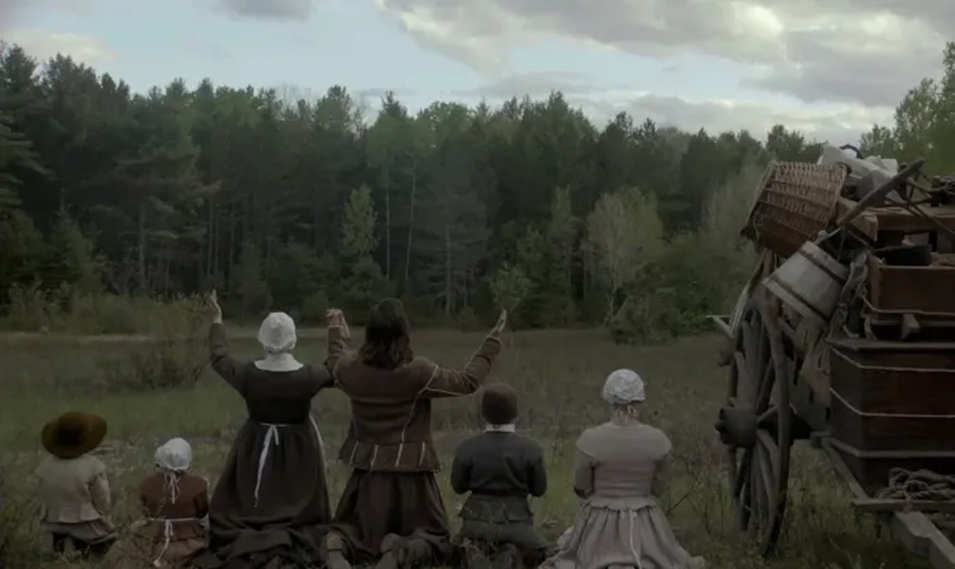
The Witch (2015)

THE GENRE

Scholarship about horror often highlights the genre’s ability to “render abject the subject of its gaze” (Chambers 12). 1980s body horror resonated with the AIDS epidemic, just as the Saw franchise is best understood in the context of the invasion of Iraq, and the zombie craze of the 2010s in the context of the Great Recession. Despite its rapid cult following, there is less consensus about folk horror.

Jamie Chambers notes that “theoretical approaches to folk horror remain in their infancy” (10) and Paul Cowdell writes that while “clear generic definitions are elusive,” the genre has a distinct atmosphere: folk horror films “rely on location in a landscape that acquires almost the status of an active character” whose influence results in what Adam Scovell calls “‘skewed belief systems and morality’ [enabling] the plots’ actual ‘happening/summoning’” (Cowdell 296).

Others have argued that folk horror exploits rural communities as sensational and backwards. As Chambers puts it, “folk denotes a productive way of seeing with an unstable inference of us and them” (17). Elsewhere, Cowdell argues that folk horror necessarily relies upon interdisciplinary interests in folklore studies, claiming that “The Wicker Man, then, would not exist without the development of an actual discipline of folklore” (309).

Is folk horror merely the abjection of folklore? While I find it admirably subversive to suggest that because the movies we love are just reboots of older folk stories, then we are not, in fact, morally or socially better than our ancestors, I also find this definition limiting. With obvious exceptions (The Witch), the legends in folk horror are usually fictitious. The traditions that drive the imagined peasant communities in Children of the Corn, The Wicker Man, and The Blood on Satan’s Claw are diegetic imitations of actual folklore.

Instead, folk horror is defined by the countryside, historicized between economic relations. Antonio Gramsci’s words on the subject are now famous to the point that they’re a meme: “The old world is dying, and the new world struggles to be born. Now is the time of monsters.” The question I want to pursue is whether or not those monsters are the peasants left behind by modernity, or modernity itself.

THE UNHOLY TRINITY

Most scholars agree that three unrelated English films, known informally as the Unholy Trinity, mark the first era of folk horror: Witchfinder General (1968), The Blood on Satan’s Claw (1971), and The Wicker Man (1973).

Witchfinder General is based on the real self-proclaimed witchfinder Matthew Hopkins, who abuses his authority in seventeenth century England. The Blood on Satan’s Claw portrays the satanic influence of Pagan artifacts on rural youths, who can only be saved by a witchfinder-like state agent. Meanwhile, The Wicker Man depicts a neo-Pagan Scottish cult whose mere existence challenges the English state’s internal stability by selecting a devout Anglican police officer for human sacrifice.

The most striking thing about these films is how ideologically incongruent they are. Whatever binds them together, then, is their shared depiction of an unresolved conflict between agricultural communities and an increasingly powerful class of landowners.

ENCLOSURE AND THE COMMONS

A Field in England (2013).

Economies in Europe were structurally and politically diverse during the thousand-year reign of feudalism, but were mostly built on social contracts between peasants who lived on the land and lords who held religious and political titles to that land. Peasants were also granted access to parcels of common land useful for procuring firewood, hunting and gathering, and grazing.

As early as the 1200s, feudal lords began violating those contracts by terminating customary rights to fish, graze, hunt, or harvest. Ellen Meiksins Wood writes that “enclosure meant the extinction, with or without a physical fencing of land, of common and customary use rights on which many people depended for their livelihood” (83). A much larger wave of enclosures began in the sixteenth century, placing the means by which one lives to see another day—food, water, and shelter—exclusively under market forces.

As a result, enclosure could lead to the elimination of small owner-occupiers, who were bought out by large proprietors” (623), writes S. J. Thompson. Meanwhile, Silvia Federici notes the relationship between enclosure and the violence of the witch trials. In Caliban and the Witch, she writes, “women were those who suffered most when the land was lost and the village community fell apart” because “a nomadic life exposed them to male violence” (73).

Folk horror calls back to what capital presumes to be extinct: the practice of holding resources in common. Witchfinder General portrays the agents of enclosure as monstrous, cruel figures. In contrast, The Blood on Satan’s Claw suggests that enclosure is a necessary step in social progress, and The Wicker Man depicts a community struggling to recreate premodern agricultural (emphasis on cultural) conditions.

THE HORROR OF MATERIAL CONDITIONS

One central premise of folk horror is that people and wilderness should be separate, that monstrosity emerges from too close an association with the land. This is the logic of Enlightenment-era liberalism. John Locke explicitly argued that land can only be considered property if the people on that land use it for profit, or as he called it, improvement.

Thompson writes that “improvers defended enclosure on the grounds that it was more compatible with individual liberty than the open-field system it replaced” (639). Employing the rhetoric of natural liberty and natural rights, the agents of enclosure redefined nature itself. Locke argued that “the value inherent in land comes not from nature, but from labor,” which in Wood’s assessment means that, for Locke, “unimproved land is waste” (Wood 85). In the sixteenth century, improvement looked like agriculture. By the 1960s, agricultural spaces had replaced the commons as the imagined backwaters of modernity.

The Wind (2018)

This is much more evident in the US corollary to English folk horror, known as hicksploitation. Ranging from Deliverance (1972) to The Texas Chainsaw Massacre (1974), American “hillbilly horror” is arguably more exploitative. In these films, isolated (usually white) communities in overgrown landscapes become monstrous. These films center harsh landscapes that are difficult to “improve,” despite the most industrious efforts of long-gone colonialist projects, which themselves become the subject of more recent American folk horror. The Witch (2015) and The Wind (2018) both emphasize the isolation of frontier spaces.

For Chambers, “the pleasures of the folk aesthetic frequently arise from depictions of cultural-geographic difference” (26). While I think Chambers underestimates the critical thinking skills of horror fans, his observation that the appeal of films like The Wicker Man for western liberal audiences is an imagined rural authenticity seems correct. Folk horror scratches a very particular itch; it confirms about ourselves whatever we want it to.

Today, there are dozens of studies about a contemporary epidemic of loneliness, contrasting a genre of memes about the desire to leave modern society and live in a cabin in the woods, to “retvrn with a V” to “the past,” because “medieval peasants” presumably worked fewer hours and because life was somehow “better” in “the past.” These memes traffic in the same metonymy for “the good old days” that folk horror encodes with monstrosity.

With more scholarship, I want to explore the ways that recent folk horror has reinterpreted landscapes from wastelands into spaces of mystery and open exploration, ecologically but also historically and economically, where present conditions can be seen, with both admiration and disgust, in sharp relief from afar.


Chambers, Jaime. “Troubling Folk Horror: Exoticism, Metonymy, and Solipsism in the ‘Unholy Trinity.’ Journal of Cinema and Media Studies, vol. 61, no. 2, Winter 2022, pp. 9-34. EBSCO, https://doi.org/10.1353/cj.2022.0014. Accessed 3 October, 2023.

Cowdell, Paul. “‘Practicing Witchcraft Myself During the Filming.’ Folk Horror, Folklore, and the Folkloresque.” Western Folklore, vol. 78, no. 2, Fall 2019, pp. 295-326. JSTOR. https://www.jstor.org/stable/10.2307/26864166. Accessed 18 October, 2023.

Federici, Silva. Caliban and the Witch. Autonomedia, 2014.

Thompson, S.J. “Parliamentary Enclosure, Property, Population, and the Decline of Classical Republicanism in Eighteenth-Century Britain. The Historical Journal, vol. 51, no. 3, 2008, pp. 621-642. JSTOR, https://www.jstor.org/stable/20175187. Accessed 19 March, 2024.

Wood, Meiksins Ellen. The Origins of Capitalism. Monthly Review Press, 1999.